A portfolio of entanglements exploring choreographies of placement, mapping, intervention, improvisation, and connection.
Material and conceptual processes unfold and intertwine, extending beyond the work itself to include the observer. The observer becomes part of the process—adding, shifting, subtracting, and merging with the work as it evolves.
The works are never entirely fixed. Instead, they continually emerge through these moments of encounter and connection, shaped by the movement between material, place, action, and observer.
2021 My Life in Hackney Part Two

My Life in Hackney Part Two shifts between notions of here and there, past and present, outdoor place and indoor space, and static text and dynamic sound.
Three large texts—Injury, Death, and Epiphany—are woven together through the geological processes of the lands that bore the personal events described in them. The texts are grounded by the rich, textured sounds of everyday Hackney.
A Work in development, Hundred Years Gallery, 1–31 June 2021
Using the gallery as a studio, Lemley edited the texts throughout the duration of the exhibition. They were then reprinted and hung over the earlier versions, making the process of editing visible within the work.
The sounds of everyday Hackney were recorded twice a week for four weeks, for up to eight hours each day. Nine microphones—including geophones, midrange microphones, and high-frequency microphones—were positioned across three windows of the artist’s flat on the York Row Estate.
An energy of push and pull emerges between listening and reading. This is realised through three sets of speakers positioned behind each text: sub-bass, midrange, and specialist tweeter. The sound holds the reader within moments of seemingly disconnected elements, as well as in serendipitous encounters between sound and word.
Here, sound becomes an ordinary, whispering presence—intermittently repeating, heightening and deepening without discernible or consistent rhythm. It follows the broken melody of the poetic text, creating a shifting relationship between what is read, what is heard, and what is remembered.
2020 'surfacings III - anything which comes forth'
'surfacings III - anything which comes forth' commissioned for Modify
Group sounding improvisations with Will Crosby in collaboration with Mary Lemley and Nicol Parkinson.
Exhibited through QR code @ Meno Parkas, Düsseldorf, Germany
7 August-7 September 2020.
2 September — 1.30pm — 30’
William Crosby: cake tins, plant pots, metal garden ornaments, whiskey glasses, cello bow, guitar. reading - The Mushroom at the End of the World (2015), Anna Tsing
Mary Lemley: everything but the bathroom sink. voice, bass, metal ruler. Reading - My Life in Hackney, Part One (2001), Mary Lemley
Nicol Parkinson: terracotta seed bowl, guitar, 9V battery amplifier, stovepipe
From the album 'surfacings III - anything which comes forth'. William Crosby
2020 Come Hell or High Water: Thunder Moon
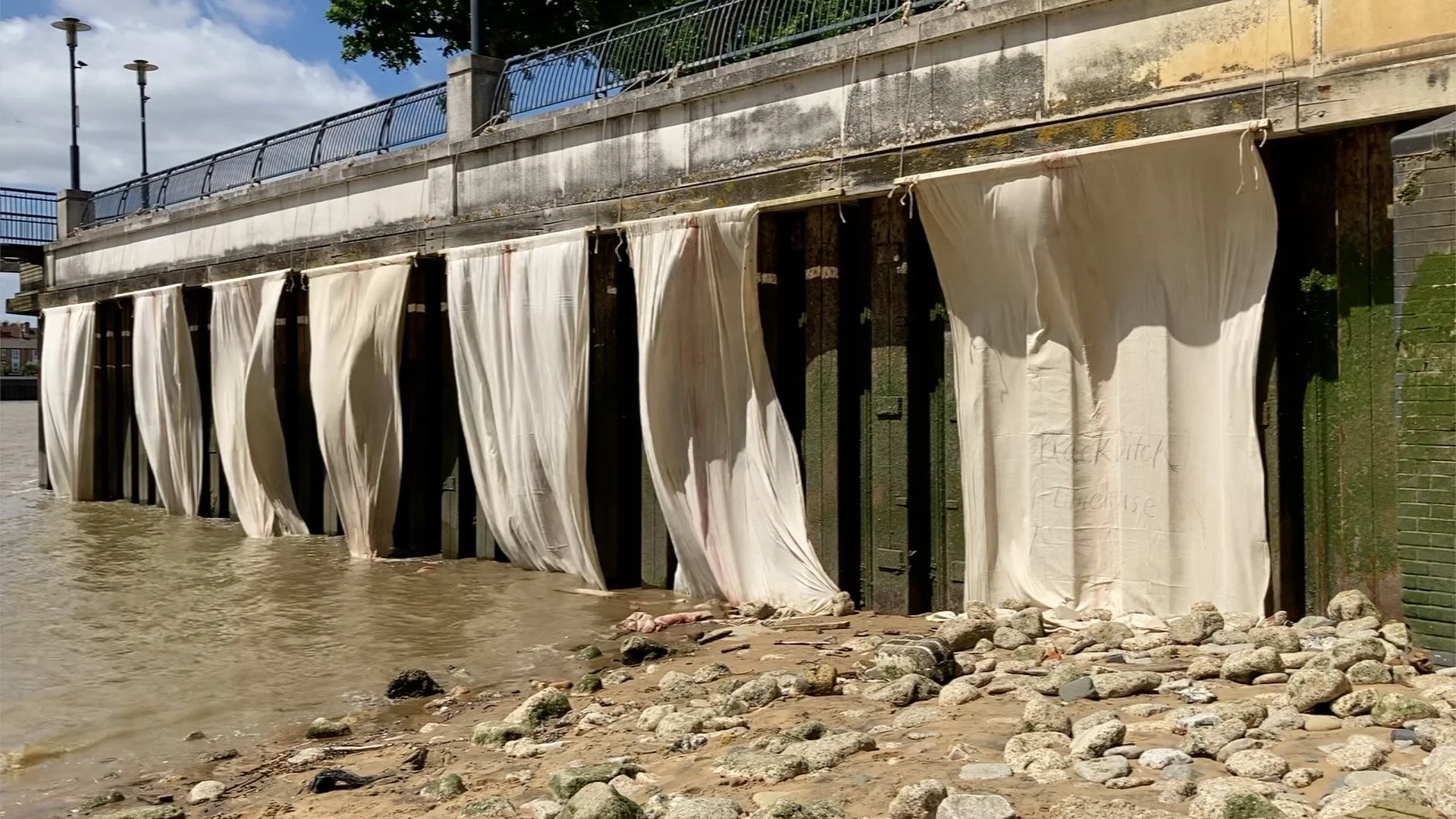
These Fragments We have Shored Against Our Ruin
Site Specific Process Work - One day
calico cloth/sandbags/wood/hessian rope/River Thames
Rehanging the original fourteen cloths from the 1992 These Fragments We have Shored Against Our Ruin on July 5th from morning low tide through high tide to evening low tide for Anne Bean’s monthly Come Hell or High Water programme on the Thames foreshore at Limehouse.
Press The Art Newspaper Wuhan clang: the sounds of the Chinese city ring out over London’s River Thames, Louisa Buck, July 6 2021
2017 Peace Love and Anarchy
Peace Love and Anarchy = Freedom and Fun for Ever is an exhibition as a mood board.
Was the first partial retrospective document of 64- 65 Guildford Street a squatted house where a lot happened to a lot of people over a short space of time a long time ago. Milch, the gallery that claimed to reach the parts that other galleries cannot reach was started here and ran on in different locations, and with a new lead for some 13 years or so. A nuanced 18th-century house, with generous spaces, floor boards, light and height, and delicate textures.
Opening by coincidence on election night, June 8th, in a new London, remade daily with glass and steel, this exhibition, through image, artefact and ephemera, provides a moment of reflection on the immense social and political changes that have transformed London over the past 29 or so years since this house was occupied. The law of the land in 1988 made squatting a double house near Russell Square, both possible and legal, we lived and worked and partied, in conducive, cocoon architecture for 5 eventful years. It was seminal. To consider this in contemporary language, this mood board of an exhibition might also stand as some kind of beginning for a case study of the multiple cultural impacts that have subsequently developed from the chance encounters that our home 64-65 Guilford Street made possible. From this house cultural legacies can be found now in the Tate Collection, in New York’s Metropolitan Museum, in hearts and minds, creating top content in Hollywood, inscribed on, and pierced into the bodies of some millions of millennial barista’s right across our glass steel globe.
Merlin Carpenter, Dominic Berning, Alex Binnie, Christine Binnie, Hamad Butt, Merlin Carpenter, Steve Chivers, Trevor Clarke, Simon Costin, Fiona Dennison, Douglas Gordon, Georgie Hopton, Cheryl Hubbard, Moan Kehr, Mary Lemley, Lawren Maben, Cassius Matthias, Nazrin Montag, Christopher Muller, Simon Patterson, Simon Periton, Josephine Pryde, Nils Norman, Nick Reeves, Carolyn Roy, Nicola Tyson, Simon Vincenzi, Anand Zenz
Co-ordinated by Sarah Staton, With thanks to DACS, Dan Mitchell and all contributors
2010 Residency/ HMS Ganges

Logarithmic spiral drawn on OS map from Shotley Point marking video locations.

A clip from the Residency video work. These slow pans describe the logarithmic spiral from the map moving outward from the centre.
commissioned by Commissions East
From 2009–2010, a commissioned residency at the HMS Ganges Museum at Shotley Point, on the River Orwell in Suffolk, resulted in the two-screen video work Residency / HMS Ganges.
The work traces the history of the HMS Ganges naval training school, situated between Suffolk’s two great rivers, the Orwell and the Stour. Drawing on hundreds of archival photographs of boy seamen dating back to the 19th century, the work moves between the museum and the surrounding rural and industrial landscape.
Across the two screens, the archival images unfold alongside locations that spiral outward from the museum, following the landscapes and places once walked by the young men whose histories are held within the archive.
Press
The Telegraph, The Martello towers: An artistic entente on the coast, Sophie Campbell, June 29 2010.
1999 - 2019 My Life in Hackney Part One

Digital Photographs
Ongoing since 1998.
The series began with Martin Reynolds surveying my two-storey council flat and mapping it into 50 cubic-centimetre units, creating a three-dimensional grid from which objects could be harvested and photographed.
Each object, treasured for a brief moment, is removed from its context and photographed digitally against a carefully lit white space. Using an alphanumeric cataloguing system, each image is first assigned a grid coordinate and then numbered sequentially.
In this process, the everyday is transformed into data: objects become images, images become binary code, and everything is reduced to ones and zeros.
Everything is Nothing.
Performance David Gales’ Peachy Coochy Night, My Life in Hackney Part One: 20 Objects from One Area. 2001
Exhibited Presque Rien, Laure Genillard Gallery October 2008 –January 2009 Upside Down/ Inside Out, Kettles Yard Cambridge, July – September 2009
Published On Maps and MappingPerformance Research, Volume 6.2, Summer 2001 Art Monthly Dec-Jan 08-09 Updside Down/ Inside Out Exhibition catalogue, Kettles Yard, University of Cambridge Press, 2009
1996 tourist

Cardiff Shopping August 1996

Cardiff Shopping with placed painting September 1996

Cardiff Shopping, detail, September 1996

Tan-Y-Bwlch Woods August 1996

Tan-Y-Bwlch Woods with placed painting September 1996

Tan-Y-Bwlch Woods, detail, September 1996
commissioned by Central for Performance Research
From the On Tourism issue of Performance Research Journal (volume 2, no.2, Summer 1997).
In August 1996, Lemley spent a week in Wales with Judie Christie, Trisha Rhodes and Adam Hayward from the Centre for Performance Research. They were hosts and guides to the sites being considered for the forthcoming Tourism and Identity conference in September 1996. Visiting places Lemley had never been before, the experience was approached from the position of a tourist—and, as a tourist, Lemley took photographs.
Back in London, Lemley selected 100 of these photographs and painted 100 postcard-sized watercolours. When returning to Wales in September for the conference, Lemley placed each watercolour back into the original viewpoint from which its photograph had been taken.
By placing each image back into its vanishing point, the paintings were sent out in search of their lost identity.
Lemley did not tell anyone about the activity during the conference unless asked. No one asked. On the final day, slides of the original photographs were shown alongside slides documenting the watercolours in their returned locations. No one had connected Lemley’s furtive activity of placing the paintings at the Welsh tourist sites, even when they had encountered them along the way.
Some members of the audience spoke about how they believed they had been more observant than an ordinary tourist. The work brought into focus the extent to which everyone had adopted the mindset of a tourist, even while discussing the emptiness of tourism itself.
The photographs here document this journey. The first image is the original tourist photograph taken in August; the second, taken in September, shows the watercolour returned to the place from which the photograph was made; and the final image is a close-up of the painting.
1994 Listening Ground Lost Acres

confluence of River Bourne and River Avon with glass trig point


Triangular Copse with glass trig point.


Trinagular Copse Stream of words from map page.
in collaboration with Graeme Miller
Lost Acres was Mary Lemley’s contribution to Listening Ground / Lost Acres, a large-scale site-specific work mapping approximately 100 square miles of landscape in and around Salisbury, Wiltshire. Co-commissioned by Artangel and Salisbury Festival, the project brought together Lemley’s artist’s book and glass markers with Graeme Miller’s sound installation and walking work.
Lemley’s Lost Acres took the form of a customisable artist’s book containing maps, texts, historical material, local journals, myths and interviews. The book offered a network of possible routes through the landscape, leading walkers between ancient sites and ordinary, often overlooked places. Rather than providing a single prescribed journey, it allowed each participant to construct their own path through the territory.
In collaboration with glassmaker Jonathan Anderson, Lemley created a series of 29 tall, crystal-glass triangulation points. Sited across the landscape, these markers indicated places where the various routes crossed and re-crossed the central alignment of Miller’s sound walk. The glass points acted as both survey markers and mysterious interventions in the landscape—visible traces of an alternative mapping system.
Miller’s Listening Ground followed a straight alignment running from Stonehenge through Clearbury Ring, Old Sarum and Salisbury Cathedral. Using lightweight headphones and remote transmission, walkers encountered a layered composition of music, spoken text, overheard conversations and recordings as they moved through the countryside.
The two works were brought together through the act of walking. Lemley’s map-book generated multiple possible journeys, while Miller’s sound walk established a central line through the landscape. The audience became the connecting element, physically activating the relationship between map, marker, sound and place.
For Lemley, the landscape became a kind of memory theatre: a work that could not be encountered in its entirety from a single viewpoint, but had to be enacted through movement, repetition and the accumulation of individual experiences. The work existed in the space between the map and the ground, between the imagined landscape and the landscape physically walked.
Glass triangulation points: Jonathan Anderson
Co-commissioned by: Artangel and Salisbury Festival
Co-commissioned by Artangel and The Salisbury Festival, and Southern Arts.
Press Louisa Buck on BBC Radio 4 Kaleidoscope, reviewed by Maureen Paley. Sept 1994
The Sunday Times, Robert Hewison, September 1994
1992
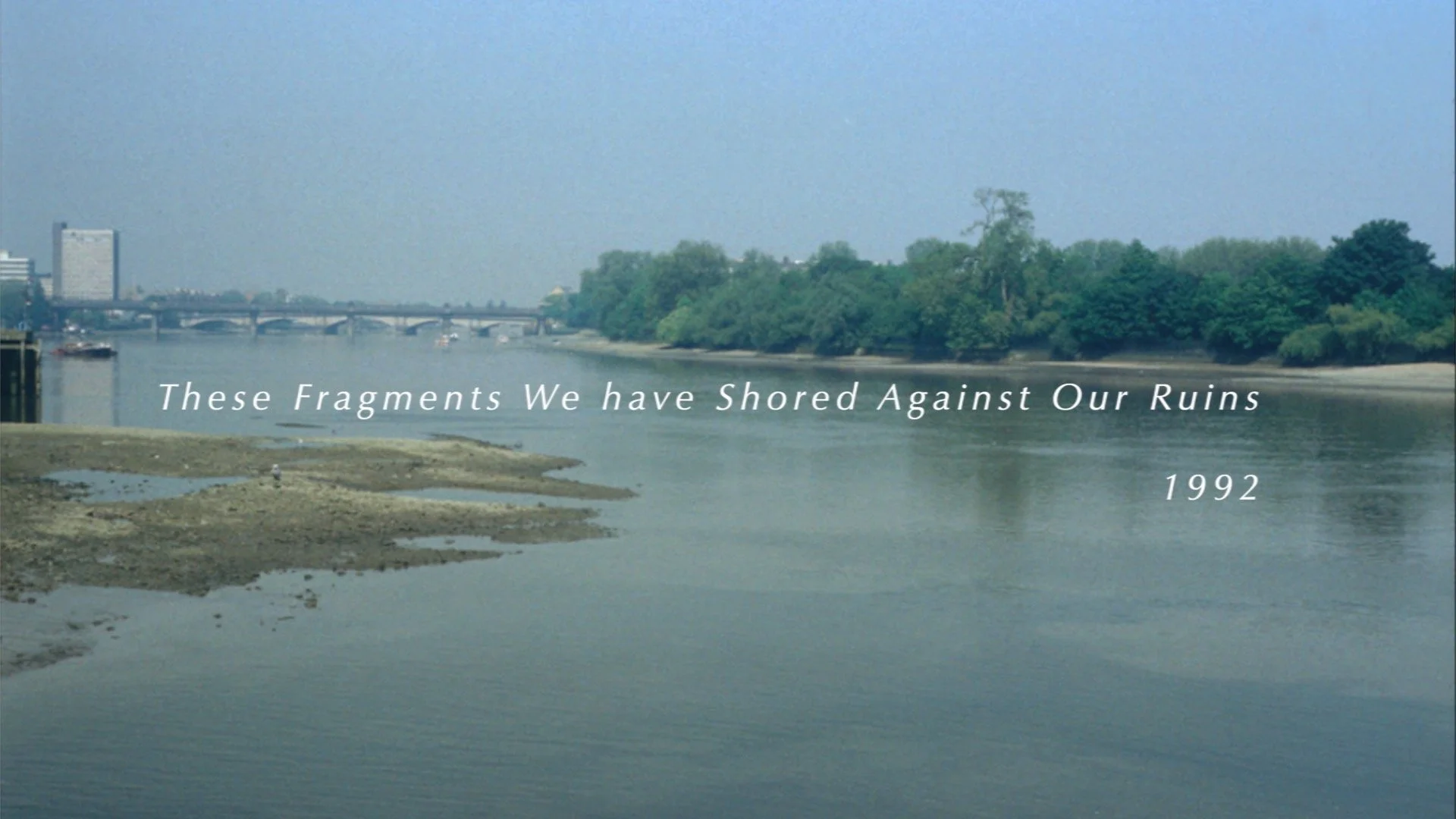
These Fragments We Have Shored Against Our Ruin
Site-Specific Process Work
Materials: calico cloth, sandbags, wood, hessian rope, River Thames
Duration: two weeks
A site-specific performance and installation made in response to the tides, histories and shifting geography of the River Thames and its fourteen former tributaries.
Over the course of two weeks, seven-metre lengths of calico cloth were suspended in the river at the location of each former tributary. Placed at low tide and left through a full turning of the tide, the cloths absorbed the residue of the river—mud, silt, water, stains and other traces—creating temporary records of each location and its changing relationship to the Thames.
Each cloth was then retrieved from the river and carried back to Trinity Buoy Wharf, where it became part of an evolving installation. Re-hung within the gallery space, the accumulated marks and residues formed a visual record of the journey through the river’s landscape. Each tributary was also accompanied by a bookwork, extending the physical traces of the river into histories, fragments and textual records.
The work operated between mapping and memory, process and documentation. Rather than representing the river, the materials were allowed to register its physical presence directly. The tide became both collaborator and clock: determining when each work could be made, how long it remained in the water, and what traces were left behind.
The resulting installation brought together fourteen fragments of the Thames, each carrying the particular residue of a place that had once been connected to the river but had since disappeared from its visible course.
Funded by London Arts Board (GLA), London Dockland Development Corporation, and the Elephant Trust.
Reviews Time OutArt Rose Jennings listed August 26th – Sept 2,1992.
The IndependentThe Watercolour World Rosie Millard Sept. 4, 1992.
The Observer Water Colours by the Thames, P Hughes, Photo Sue Adler August 9th 1992